
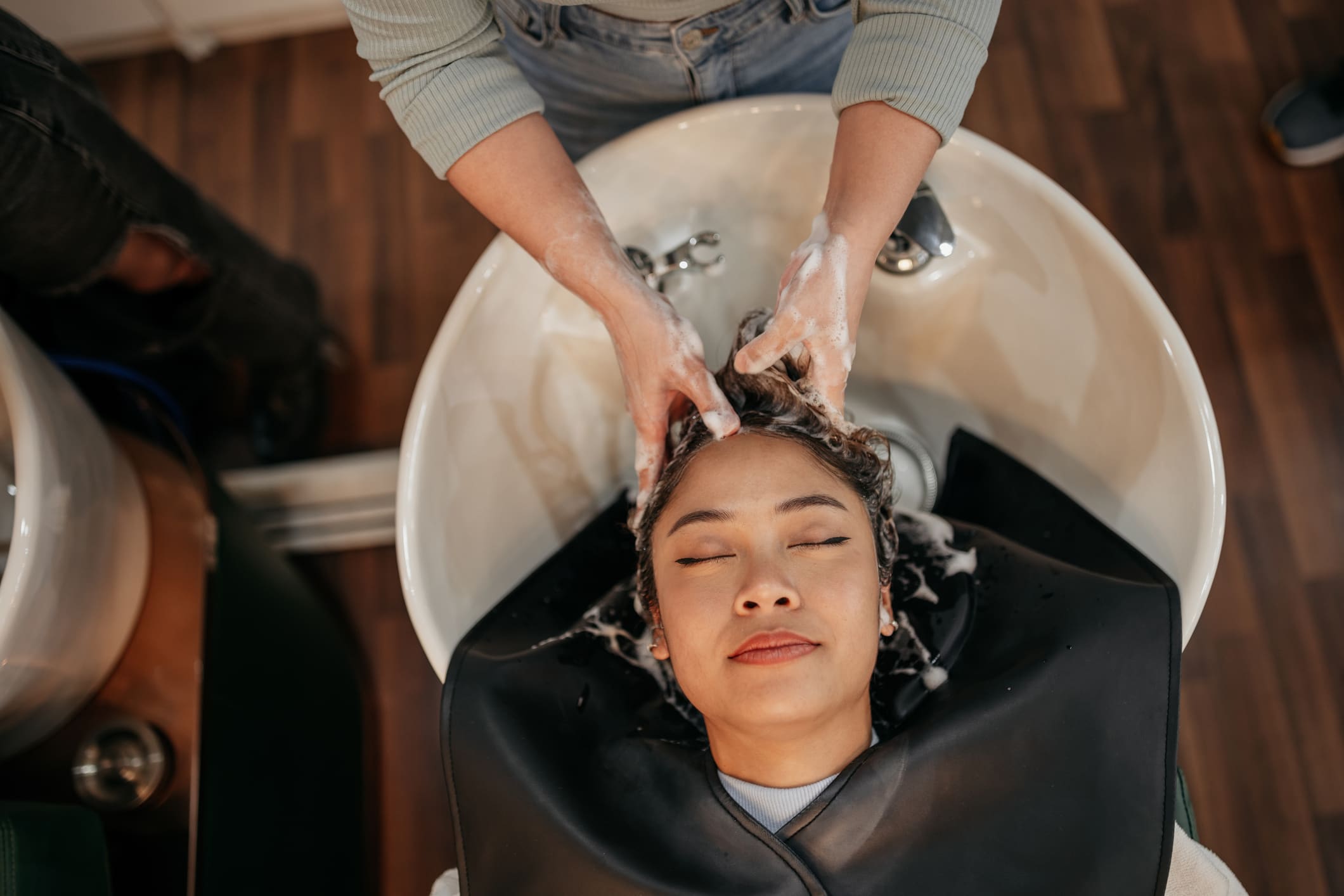
GLP-1 medications have changed the conversation around weight management. Semaglutide, tirzepatide and other medications in this category can produce significant weight loss and have become increasingly common among the clients sitting in our salon chairs every day. Along with questions about changing clothing sizes, facial volume and body composition, another concern has started coming up more often: “Why am I suddenly losing so much hair?”
If you've recently started a medication such as Wegovy, Ozempic, Zepbound or Mounjaro and noticed more hair in the shower, on your brush or around your bathroom sink, there may be a connection. Hair loss has now been documented in clinical trials and observational studies involving several GLP-1-based medications. The American Academy of Dermatology also recognizes thinning hair as a potential issue for patients taking these drugs, although researchers are still working to determine exactly why it happens. The important distinction is that this doesn't necessarily mean the medication is directly damaging your hair follicles. In many cases, dermatologists believe the more likely explanation is something we have discussed before at Oscar Giovanni Salon & Spa: telogen effluvium, a temporary shedding response that can occur when the body goes through a significant physiological change.
First, What Do We Mean by a “GLP-1”?
GLP-1 stands for glucagon-like peptide-1, a hormone involved in blood sugar regulation, appetite and digestion. Medications that act on the GLP-1 pathway can help people feel full longer, reduce appetite and improve blood glucose control. Semaglutide is the active ingredient in Ozempic and Wegovy. Tirzepatide, used in Mounjaro and Zepbound, acts on both the GIP and GLP-1 pathways, so technically it belongs to a slightly different class, although it is commonly discussed alongside GLP-1 medications.
These drugs were originally developed primarily around diabetes and metabolic disease, but their ability to produce substantial weight loss has dramatically expanded their use. As more people take them, and remain on them for longer periods, dermatologists are getting a clearer picture of some of the changes that can accompany treatment, including changes involving the skin, nails and hair.
So, Do GLP-1 Medications Actually Cause Hair Loss?
There is now enough evidence to say that an association exists. What researchers cannot yet say with certainty is whether the medication itself directly causes the majority of that hair loss. A 2026 meta-analysis examining nine interventional studies and more than 4,000 GLP-1 users found that people receiving GLP-1-based therapies had a significantly greater risk of reported hair loss than those receiving placebo. Across the studies, the overall rate of hair-loss events among users was approximately 3.9%.
A separate 2026 systematic review found the strongest signals with semaglutide and tirzepatide, while telogen effluvium and androgenetic alopecia were the two most frequently identified types of hair loss. The authors also found that rapid weight loss repeatedly emerged as a likely contributing factor.
Even the prescribing information for the medications reflects the pattern. In Wegovy weight-management trials, hair loss was reported in 3.3% of adults taking the 2.4 mg dose compared with 1% of people receiving placebo. At the higher 7.2 mg dose studied in clinical trials, the rate was 5.8%. Novo Nordisk's prescribing information specifically states that the reported hair-loss reactions were associated with weight reduction.
The signal is particularly noticeable in Zepbound's clinical-trial data. Eli Lilly reports that hair loss occurred more frequently among women receiving Zepbound than among men, with 7.1% of female patients reporting hair loss compared with 1.3% of women receiving placebo. The prescribing information likewise states that these reactions were associated with weight reduction.
Those numbers don't mean that everyone taking one of these medications will lose hair. Most will not. But they do tell us that the concern clients are describing is real enough to have appeared consistently in both clinical trials and more recent dermatology research.
The Bigger Clue May Be the Weight Loss Itself
Here's where the story becomes more interesting. Hair follicles are surprisingly sensitive to major changes in the body. Significant illness, childbirth, surgery, psychological trauma, extreme dieting and rapid weight loss can all disrupt the normal hair-growth cycle. That is why someone can experience hair shedding after COVID-19, after having a baby, after recovering from surgery, or after losing a substantial amount of weight in a relatively short period of time.
The American Academy of Dermatology explains that dermatologists currently believe sudden weight loss is an important reason some patients using GLP-1 medications develop thinning hair. Researchers have not yet ruled out a more direct effect of the drugs on the hair follicle, but the evidence isn't strong enough to say that the medication itself is the sole cause. This makes sense when you look at what happens biologically during rapid weight loss. Your body has to adapt to a significantly different level of energy intake and body mass. Appetite may decrease dramatically. Meals may become smaller. Protein intake may fall unintentionally. Some people experience nausea or other gastrointestinal side effects that further reduce how much they're eating. For the body, all of that can represent a considerable physiological shift. Hair is not essential to survival. When the body perceives a major stressor or nutritional shortage, maintaining active hair growth isn't necessarily its highest priority.
We're Talking About Telogen Effluvium, Again
If you read our article about hair shedding after COVID-19, the mechanism will sound familiar. Most scalp hair normally remains in the anagen, or active growth, phase. A smaller portion is resting in the telogen phase before eventually shedding. With telogen effluvium, a major stressor pushes an unusually large number of follicles into the resting phase around the same time.
Those hairs don't immediately fall out. That delay is important because it explains one of the most confusing parts of GLP-1-related shedding. You may begin losing weight and feel perfectly fine, only to notice excessive hair shedding several months later. By then, you may not automatically connect what you're seeing in the shower to what was happening with your weight months earlier. Telogen effluvium generally produces diffuse shedding throughout the scalp rather than one isolated bald patch. The ponytail may feel thinner. The part can appear wider. Your stylist may notice less overall density. Shampoo days can become alarming simply because you're seeing so many hairs release simultaneously. For many people, however, the follicle itself remains healthy. The hair has entered the wrong phase at the wrong time; the follicle hasn't necessarily stopped functioning permanently.
The Speed of Weight Loss May Matter
Not everyone who loses weight experiences telogen effluvium. The rate of change may be part of the equation. Newer research examining GLP-1 therapies and hair loss repeatedly points toward rapid weight reduction as an important potential contributor. A 2026 systematic review found that tirzepatide, which tends to produce especially substantial weight loss, was also frequently associated with telogen effluvium in the available literature. Researchers nevertheless caution that prospective studies are still needed before we can establish exactly how much risk comes from the medication, the amount of weight lost, nutritional changes or some combination of the three. That uncertainty matters because the answer probably isn't simply “Ozempic makes your hair fall out” or “Zepbound makes your hair fall out.” The biology appears to be considerably more complicated.
Eating Less Can Also Mean Getting Less of What Hair Needs
GLP-1 medications can make eating substantially less feel surprisingly easy. That is part of why they work so effectively for weight management. The downside is that a smaller appetite does not automatically produce a nutritionally complete diet. Hair production requires energy, protein and micronutrients. If someone suddenly eats half as much food as they previously did without paying attention to what remains on the plate, nutritional intake can change significantly.
The American Academy of Dermatology specifically notes that patients taking GLP-1 medications may consume less of the protein, vitamins and nutrients needed to support normal hair growth. Protein is particularly relevant because hair is made primarily of keratin, a protein. Iron status, vitamin D, zinc and other nutrients may also be evaluated when a patient presents with diffuse shedding, depending on their medical history and symptoms.
That doesn't mean everyone taking a GLP-1 should immediately start taking high-dose hair supplements. As we discussed in our article on telogen effluvium, blindly supplementing nutrients isn't necessarily helpful and excessive doses of certain nutrients can create their own problems. If shedding becomes significant, a physician or dermatologist can decide whether blood work is appropriate and determine whether a genuine nutritional deficiency needs to be corrected.
Is This Why Women Seem to Notice It More?
There is some evidence that women may report GLP-1-associated hair loss more frequently than men. The prescribing information for both Wegovy and Zepbound shows higher rates of reported hair loss among female trial participants. Newer reviews of the literature have also found a disproportionate number of reports involving women. Researchers don't yet have a definitive explanation. Hormonal differences, underlying female-pattern hair loss, nutritional factors, differences in treatment populations and simply being more likely to notice or report changes in hair density could all contribute. There is another possibility worth mentioning. Telogen effluvium can sometimes reveal thinning that was already developing underneath it. Someone with early androgenetic alopecia—commonly called male- or female-pattern hair loss—may not notice gradual thinning for years. Suddenly removing a significant amount of density through telogen effluvium can make that underlying pattern much more obvious.
That doesn't necessarily mean the GLP-1 medication created the underlying pattern hair loss. It may have made something that was already progressing quietly much easier to see.
Will the Hair Grow Back?
If the shedding is truly acute telogen effluvium caused by rapid weight loss or nutritional disruption, the outlook is generally encouraging. Once weight loss stabilizes, nutrition improves and the body adjusts, the excess shedding can gradually settle and new hair can begin growing. The frustrating part is that hair recovery operates on a much slower timeline than weight loss. Even after the follicle reenters its growth phase, that new strand grows only gradually. The first thing you may notice is a halo of short hairs around your hairline or part. Overall density takes longer to recover because those new hairs have to grow long enough to contribute visibly to the rest of your hair. For someone with long hair, it can take many months before the ends feel as full as they once did.
Should You Stop Your GLP-1 Because Your Hair Is Shedding?
Not on your own.
Hair loss can be upsetting, but GLP-1-based medications may be providing important benefits for obesity, diabetes, cardiovascular risk or other medical conditions. Recent dermatology research specifically cautions against automatically discontinuing an otherwise beneficial treatment without first determining what kind of hair loss is occurring and what may be contributing to it. If you notice substantial shedding, talk with the clinician prescribing your medication and consider seeing a dermatologist. They can review the rate of weight loss, medication dose, diet, medical history and any other potential triggers. Sometimes the solution may involve nutritional changes. Sometimes another underlying cause is discovered. Sometimes the shedding simply needs time to resolve. And sometimes what looks like telogen effluvium turns out to be another type of hair loss that should be treated differently. The important thing is not to make medication decisions based on what you find in your hairbrush.
When Is It Worth Seeing a Dermatologist?
A sudden increase in diffuse shedding after significant weight loss can fit the pattern of telogen effluvium, but not every form of hair loss should be blamed on a GLP-1 medication.
Consider seeing a dermatologist if the shedding is severe or continues for months without improvement; your part continues to widen even after the shedding slows; you develop distinct bald patches; you notice redness, itching, burning, scaling or pain on the scalp; your eyebrows or other body hair are also affected; you have symptoms that could suggest anemia, thyroid disease or another medical condition; or you're simply unsure whether what you're experiencing is normal shedding. Research published over the last several years has identified both telogen effluvium and androgenetic alopecia among patients reporting hair loss while taking GLP-1 therapies. That makes an accurate diagnosis particularly important.
What Can Your Hairdresser Do?
Your stylist can't diagnose GLP-1-related hair loss, and we can't tell you whether to change a medication. What we can do is recognize changes in density, help protect the hair you have and adjust your cut, color, extensions and styling routine while your hair recovers.
At Oscar Giovanni Salon & Spa, one of the most useful things we can do is look at the hair as a whole rather than focusing only on the strands you're losing. Is the perimeter beginning to look thin? Are long layers making reduced density more obvious? Would a slightly shorter length create a stronger silhouette? Could a different part or softer face-framing shape disguise an area where the scalp is becoming more visible? These aren't treatments for hair loss but they are temporary ways to make the transition less noticeable.
Color may need to change temporarily as well. When density is reduced, aggressive lightening or repeated overlap on fragile ends may not be the best approach. Depending on the condition of the hair, your stylist may recommend more strategic highlighting, lower-maintenance dimensional color or simply spacing certain chemical services farther apart. The goal isn't to stop coloring or styling your hair because you're shedding. It is to make sure everything we're doing supports the condition of the hair that remains.
Can Hair Extensions Help Bridge the Gap?
For the right client, professionally applied hair extensions can be one of the most effective ways to bridge the period between significant shedding and full regrowth. Hair can begin growing again long before it feels full through the mid-lengths and ends. That leaves an awkward period where there may be plenty of promising new growth at the scalp but the overall silhouette still feels thinner than it did before.
Extensions can restore some of that missing density while the natural hair catches up. The operative words, however, are for the right client and applied correctly.
Hair that is actively shedding, extremely fragile or significantly reduced in density cannot always support the same amount, weight or type of extension hair that it could before the shedding began. Trying to recreate someone's previous density by simply adding a large amount of extension hair can work against the goal if the remaining natural hair is forced to support too much weight. Instead, extension work during a regrowth period should be highly customized. The stylist needs to evaluate the strength and density of the natural hair, where the shedding has occurred, how much new growth is present and whether the scalp is healthy enough for an extension service. In some cases, adding a smaller amount of hair for fullness rather than dramatic length can make a substantial visual difference while placing much less demand on the natural hair.
Placement matters just as much as quantity. Extensions should not create excessive pulling on fragile areas, and they shouldn't be used to simply cover an area that is actively losing hair without first understanding why that hair loss is occurring. If an application feels painfully tight, creates persistent scalp tenderness or places obvious tension on the natural hair, that is not something to ignore. The reason for the caution is traction alopecia, a separate type of hair loss caused by repeated pulling or tension on the follicles. The American Academy of Dermatology notes that extensions and other styles that continuously pull on the hair can contribute to traction alopecia and, when tension continues long enough, the resulting hair loss can become permanent. Dermatologists specifically advise that an extension application should not hurt; pain or a headache can be a sign that the hair is being pulled too tightly.
That doesn't mean extensions automatically damage thinning hair. It means the application needs to respect what the natural hair can safely support. A professional extension specialist should be willing to use less hair, adjust placement, change the method, delay installation or recommend against extensions altogether if the natural hair isn't currently a good candidate.
Maintenance matters, too. Regular appointments allow the stylist to monitor the natural hair as it grows, make sure attachment points remain healthy and modify the extension plan as density returns. Extensions should be helping the transition, not creating a second hair-loss problem while you're recovering from the first. For some clients, traditional attached extensions may not be the best choice during the heaviest period of shedding. Temporary density solutions, such as removable pieces or other non-tension options, may offer a better bridge until the hair becomes stronger. As regrowth progresses, aone of our stylists can reassess whether a professionally installed extension system makes sense.
Used thoughtfully, extensions can do something important that a supplement or volumizing product cannot: give someone back the look and feel of fuller hair while they wait for their own density to return. They aren't treating telogen effluvium, but they can make the months of regrowth far easier to navigate.
Be Gentle With the Hair You Still Have
Telogen effluvium happens at the follicle, so you cannot stop it simply by buying a gentler shampoo. But breakage can make thinning look considerably worse. During a period of excessive shedding, avoid creating additional mechanical stress where possible. Tight ponytails, excessive tension, repeated high heat and forceful brushing don't cause telogen effluvium, but they can damage already vulnerable hair. The AAD similarly recommends minimizing styles that continually pull on the hair because repeated tension can contribute to breakage and traction alopecia.
Use a conditioner that provides enough slip to detangle without pulling. Start brushing at the ends rather than dragging a brush through knots from the root. Reduce unnecessary heat. And remember that seeing loose hairs during washing doesn't mean washing caused them to fall out. In many cases, those hairs had already completed the shedding process and were simply released during shampooing. Avoiding shampoo because you're frightened by the hair in the drain often just means several days' worth of naturally shed hairs come out all at once during the next wash—which can look even more alarming.
Beyond Extensions
There is nothing wrong with wanting a cosmetic solution while your hair catches up. The right option depends on how much density has been lost, where it has been lost and how strong the remaining hair is. For some clients, carefully selected extensions can restore fullness through the lengths. For others, root powders, tinted scalp products and hair fibers may be more appropriate, particularly when the main concern is increased scalp visibility rather than a lack of density through the ends. Products such as Color Wow Root Cover Up, which we often use between color services, can also be applied strategically along a wider part or areas where density has temporarily decreased. Volumizing mousse, root-lifting products and lightweight texture sprays can create additional fullness without weighing down finer hair. Even changing where you part your hair can sometimes make a surprisingly significant difference.
None of these options treat the underlying shedding and that's an important distinction. Their purpose is to make the recovery period easier while the biological process happens in the background.
The Bottom Line
The connection between GLP-1-based medications and hair loss is becoming increasingly difficult to dismiss. Hair loss has appeared in clinical trials, prescribing information, pharmacovigilance databases and dermatology studies, particularly with semaglutide and tirzepatide. A 2026 meta-analysis found a significantly elevated risk compared with placebo, while current reviews continue to identify telogen effluvium as one of the most common patterns reported.
What researchers are still trying to understand is why. For many people, rapid weight loss, reduced calories, lower protein or micronutrient intake and the physiological stress of a major body change may be more important than a direct toxic effect of the medication itself. There may also be direct effects on hair biology that we haven't fully understood yet. Current evidence simply isn't strong enough to separate those possibilities completely.
So if you've been successful on a GLP-1 medication and suddenly find yourself staring at more hair than usual in the shower drain, don't assume something has gone permanently wrong. Pay attention to the pattern, talk with the medical professional managing your medication and consider seeing a dermatologist if the shedding is significant or persistent. And bring it up with your stylist, too. We may not be able to treat what is happening inside the follicle, but we can help protect your existing hair, adjust your cut and color, determine whether extensions could safely restore temporary density, disguise visible thinning and create a plan for the months while your natural hair catches up. Sometimes the number on the scale changes much faster than the hair cycle can adapt. Your hair may simply need more time to catch up—and the right haircut, styling approach or thoughtfully applied extension service can help bridge the space between hair loss and hair regrowth without sacrificing the health of the hair you're working to restore.
Research & Further Reading
American Academy of Dermatology. How Can GLP-1 Drugs Affect My Skin, Hair, and Nails? Updated February 2026.
American Academy of Dermatology. How to Prevent Hair Damage From a Weave or Extensions.
American Academy of Dermatology. Hairstyles That Pull Can Lead to Hair Loss.
Cheng P-L, et al. Glucagon-like peptide-1 receptor agonists and hair loss: A systematic review and meta-analysis. Diabetes Research and Clinical Practice. 2026.
GLP-1 Therapies and Hair Loss: A Systematic Review of Current Evidence and Implications for Counseling. 2026.
Desai DD, et al. GLP-1 Agonists and Hair Loss: A Call for Further Investigation. International Journal of Dermatology. 2024.
Rojas Lopez RF, et al. Alopecia as an Emerging Adverse Effect Associated With GLP-1 Receptor Agonists for Weight Loss: A Scoping Review. 2025.
Novo Nordisk. Wegovy Prescribing Information.
Eli Lilly. Zepbound Prescribing Information.
This article is intended for educational purposes and is not a substitute for medical advice, diagnosis or treatment. Do not stop or change a prescribed medication without discussing it with your healthcare provider.

